Blog
/
Development
Decoding 100 Years of Women's Fashion
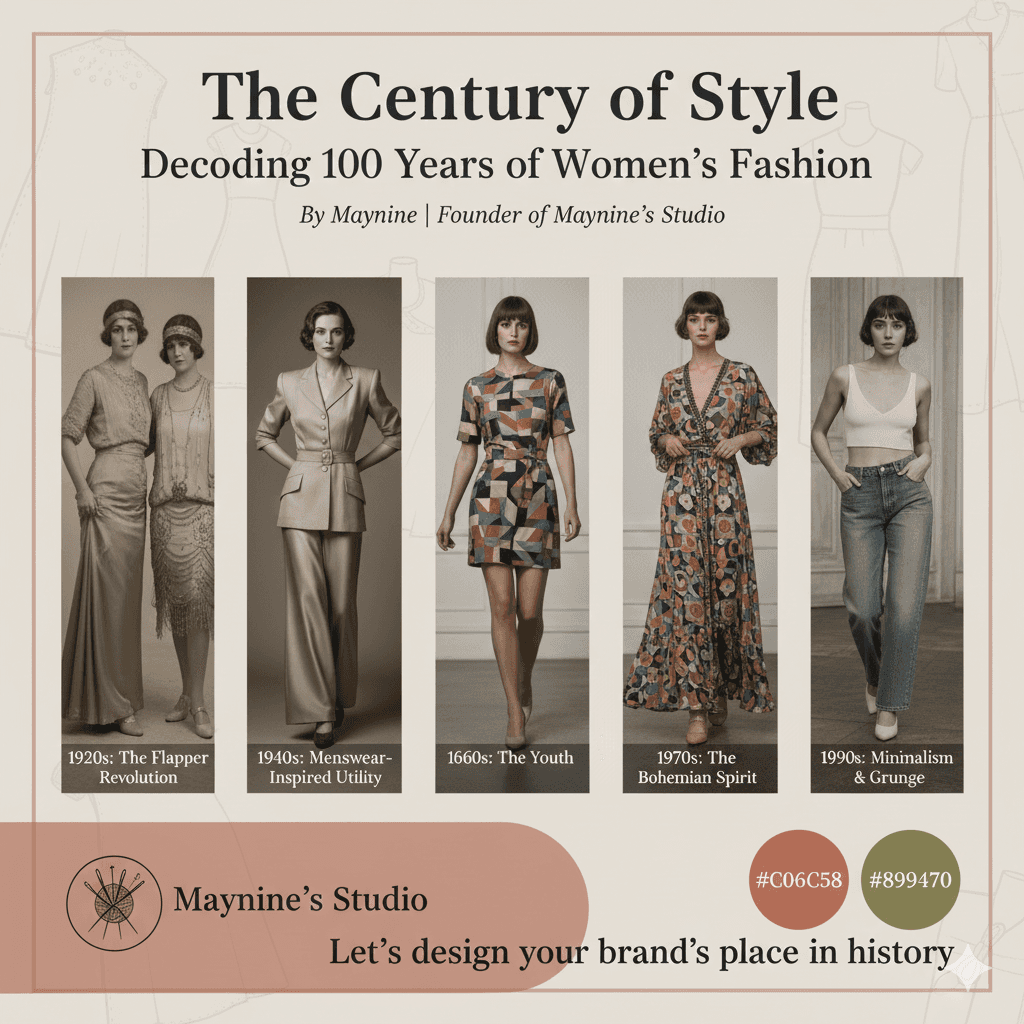
Inspired by our "Century of Style" archive. To see how these eras influence our current projects, visit our Portfolio.
Posted at
Jul 30, 2025
Posted on
Development
As a designer and consultant, I believe that every modern trend has a heartbeat from the past. When we look at the evolution of women's fashion from 1910 to 2010, we aren't just looking at changing hemlines—we are looking at a history of women’s independence, resilience, and creative expression.
In today’s Knowledge Sharing post, let’s take a journey through the decades to see how these historical shifts influence the way we build brands at Maynine's Studio.
1. The Dawn of the Modern Silhouette (1910 - 1929)
The early 20th century was the era of the "Great Pivot."
1910-1919 (The Hobble Skirt & Beyond): We saw a shift from the restrictive "S-bend" corset to high-waisted, oriental-inspired tunics. Fashion began to favor the long, lean line.
1920-1929 (The Flapper Revolution): This is where everything changed. As women gained the right to vote (1920), the silhouette became sporty and straight.
Key Influence: Coco Chanel’s "Little Black Dress" (1926).
Studio Insight: We draw from the 1920s when we want to achieve that "No Defined Waistline" look for effortless, loose-fitting linen collections.
2. Elegance Through Adversity (1930s - 1940s)
1930s (The Glamour of Hollywood): Despite the Great Depression, fashion became incredibly refined with bias-cut silk and backless gowns.
1940s (Menswear-Inspired Utility): World War II brought broad shoulders and mid-calf hemlines.
Studio Insight: My Master of High-End Coat expertise is deeply rooted in the structural tailoring of the 1940s. We take that "Menswear-inspired" shoulder and soften it for a modern feminine power suit.
3. The New Look & The Mini (1950s - 1960s)
1950s (The Ultra-Feminine): Christian Dior’s "New Look" introduced the cinched-in waist and full, dramatic skirts.
1960s (The Youth Quake): The rise of the Mod look, mini skirts, and geometric patterns.
Studio Insight: We see the 1960s influence in our Lovie project—using playful, short hemlines and bold color combinations that speak to a confident, youthful generation.
4. The Era of Individuality (1970s - 1980s)
1970s (The Bohemian Spirit): Floppy hats, maxi dresses, and a return to nature.
1980s (Power Dressing & Aerobics): From the oversized shoulder pads of the boardroom to the neon spandex of the gym.
Studio Insight: Our Embroidery & Appliqué services often look back to the artisanal "Bohemian" vibes of the 70s, modernizing them with technical precision.
5. Minimalism & The Digital Dawn (1990s - 2000s)
1990s (Grunge & Minimalism): A rejection of 80s excess. Slip dresses and "The Rachel" haircut.
2000s (The Mashup): "Vintage and Retro" became the trend. We saw skinny jeans from the 80s meet the long lines of the 30s.
Studio Insight: This era proved that "Fashion is a Remix." This is exactly what we do at the Studio—remixing historical DNA with modern digital storytelling.
Strategic Takeaway for Founders
When we build a local clothing brand today, we aren't just picking colors. We are choosing a decade to reference.
Are you building a brand of Elegance (1930s)?
Are you building a brand of Rebellion (1960s)?
Or are you building a brand of Utility (1940s)?
Understanding these 100 years allows us to create Strategic Creativity. If you want your brand to have "Heritage," you have to know which part of history you are speaking to.
Let’s design your brand’s place in history.
Inspired by our "Century of Style" archive. To see how these eras influence our current projects, visit our Portfolio.