Blog
/
Branding
Why Fashion History is Your Brand’s Secret Weapon
Want to explore how history can shape your brand's DNA? Check out our Branding Services or read more about the SHINN Journey.
Posted at
May 30, 2025
Posted on
Branding
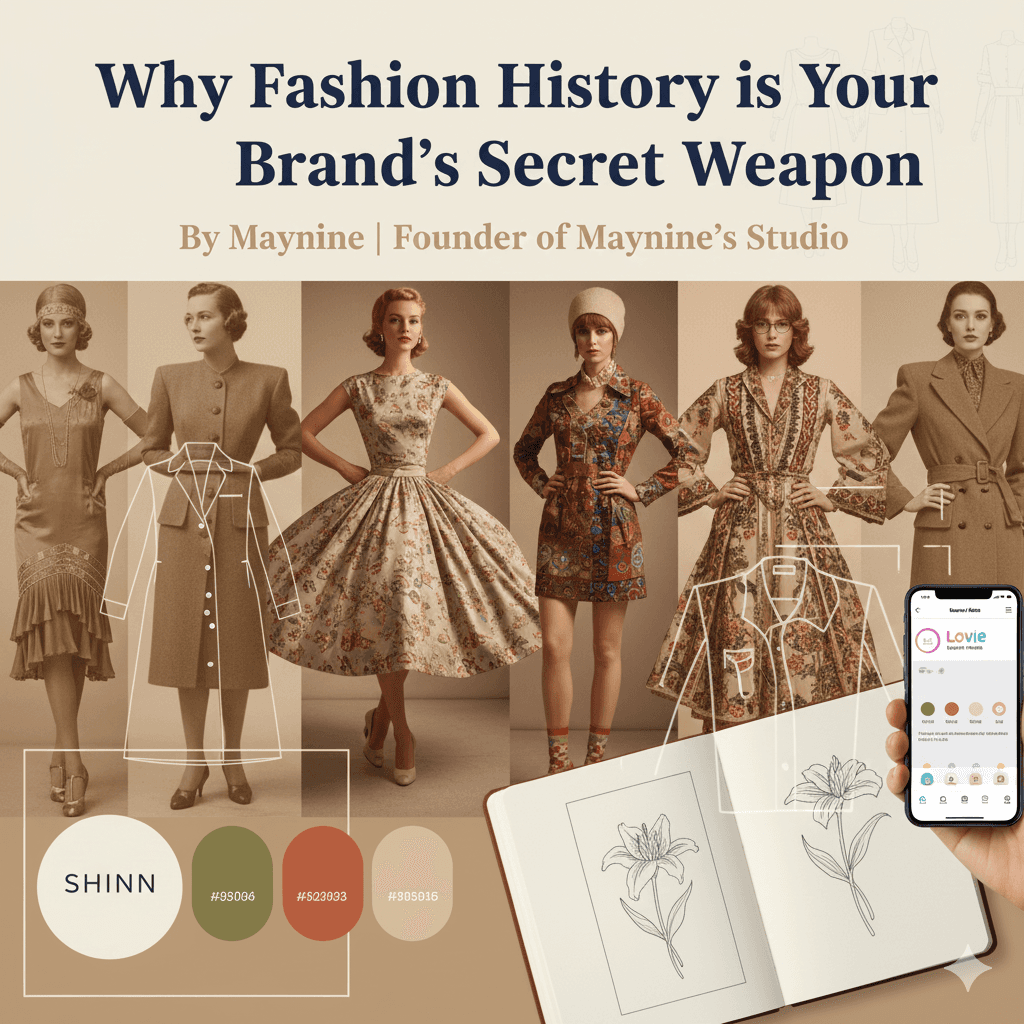
In my one-on-one brand consultancy, I often tell founders: "To design for the future, you must first master the past."Fashion isn't a straight line; it's a cycle. The "100 Years of Fashion" isn't just a history lesson—it is a roadmap of human emotion, economics, and identity.
Today, I’m breaking down the key eras from the last century and showing you how we can use these "vintage sparks" to ignite your modern local brand.
1. The Power of Silhouette (1920s - 1940s)
The early 20th century taught us about liberation and structure.
The 1920s (The Flapper): This era was about the "Straight Line." By dropping the waist and removing the corset, fashion gave women freedom.
Studio Insight: We see this influence today in our Lovie "Chill" silhouettes—prioritizing comfort and movement over restriction.
The 1940s (The Utility Era): Due to war-time fabric shortages, fashion became practical, square-shouldered, and "Uniform-chic."
Studio Insight: This is the root of our strategic pattern making. When fabric is scarce, every cut must be precise.
2. The Golden Age of Femininity (1950s)
After the war, Dior’s "New Look" brought back the hourglass. This era was about luxury, volume, and silhouette.
Key Trend: Cinched waists and full skirts.
Modern Application: At Maynine's Studio, we use these classic proportions when designing for the SHINN"May Shin" persona—creating that "Modern Graceful Woman" look that feels both timeless and expensive.
3. Rebellion & Youth Culture (1960s - 1970s)
This is where the "Youth Quake" happened. Fashion moved from the atelier to the streets.
The 1960s: The Mini Skirt and Space Age futurism.
The 1970s: Hippie culture, flares, and the rise of bohemian textures.
Studio Insight: Our Appliqué & Embroidery projects draw heavily from the 70s artisanal revival. We take those "handmade" vibes and elevate them with modern technical specs.
4. Power & Performance (1980s - 1990s)
The 1980s (Power Dressing): Broad shoulders and bold colors. It was about "Success Imagery."
The 1990s (Minimalism & Grunge): A reaction against the 80s. Clean lines, slip dresses, and the "unpolished" look.
Studio Insight: My Master of High-End Coat training often references the 80s tailoring structure, but we soften it with 90s minimalism to suit today’s "Quiet Luxury" market.
5. The Digital Shift & Sustainability (2010s - Present)
As we moved into the 2010s, we saw the rise of Athleisure, Sneaker-heads, and Tech-inspired wear. But most importantly, we saw the birth of Sustainability.
The Current Focus: 2016 was a massive turning point for digital storytelling. Brands stopped just "selling clothes" and started "selling journeys."
The Future: We are now in the era of Modern Heritage.
How Maynine's Studio Uses This History For You:
When you book a 1:1 Branding Consultation, we don't just look at Pinterest. We look at these 100 years of data.
Contextual Design: We identify which era your brand's "vibe" belongs to.
Strategic Revival: We take a technique from the 1920s (like a specific drape) and apply it to a 2025 digital-first brand like Lovie.
End-to-End Craft: We use the durability standards of the 1940s with the digital pattern-making tools of today.
The past is your foundation. The future is our project.
Want to explore how history can shape your brand's DNA? Check out our Branding Services or read more about the SHINN Journey.